Archive for the ‘MGS’ Category

Skill building in Unity

Posted: October 16, 2012 in MGS

Unity is definitely giving me more control as a designer. Before I had to rely on engineers, but working in it myself now gives me control over the obstacle and collectible placement. Like I said earlier, the controls are similar to Maya. I wish we had been given Maya as a class a semester before, because I would have been able to do much more work in the game at an earlier level rather than just the map and movement design, but oh well. I can now say that I’m comfortable tweaking around in Maya with Level Designs and object manipulation. I have been even taking assets that the artists created and cleaning them up in Maya per Kevin’s request. This is an asset pipeline that allows us to find issues with the art that that might give the Unity engine any problems. For example, I make sure that all of the polygons have proper faces and that there are not any double faces. Stuff like that. Useful skills to have as both a designer and producer and a way for me to analyze problems in future projects that may arise.

Skills I’m actively building while working in Maya:

  • Communicating with engineers: While I will never be a programmer, working alongside the engineers in Unity has given me an understanding of how they approach problems. For example as I noted earlier, Anurag approached the development of the track system from a mathematical perspective. Pace looks at the scope of the game design and makes sure it’s something the engineering side can create within our time limits. I would say that Kevin is a technical art engineer and has helped me learn how to place the assets in the game, what to look for, and ways to optimize them for the game engine. Jorge has shown me how the Kinect works and what it looks for on the body.  This has helped give me a solid understanding of what is easy and not easy for the Kinect to detect when playing with the system. By understanding the engineers, I am laying down a framework for future jobs in which I learn how to communicate more effectively with them even though I may have no idea of what they’re talking about half the time when it comes to code, engines, and systems.
  • Working with the artists: Since I’ve been learning Maya this semester, I’ve been able to help place the art assets within the game and even take them into Maya to modify them as needed under the guidance of Ashley and Kevin when needed. This frees up time for the artists to create art and the engineers to code. Also, by being within the art of the level, I have a better feel for it and can see problem areas or anticipate how a certain part may be played. By walking the talk with artists, it gives me more credibility in my analysis and input on assets and will be invaluable for future projects within the industry.
  • Confidence: Finally, delving into Maya and Unity not only gives me a new set of tools with which to work and talk about in regards to game development, but they also boost my confidence. I feel like a more valuable member of the team beyond just designer. By utilizing these skills, I can help alleviate work for others and put more of my stamp into the game.
nity 3D

More fun with Unity and asset manipulations

Posted: October 15, 2012 in MGS
Tags: , , ,

I have finally begun to dabble within Unity in a more hands on sense as our track’s have been placed out by the engineers based on my map designs. Since many of Unity’s controls are similar to Maya, it’s easy to manipulate level objects as needed and place obstacles and collectibles. Playtesting is essential and something that we need more of as we go along. The level works when being controlled via the keyboard controls but when it comes to actually using the Kinect the game gets pretty hard. We need more space between obstacles and collectibles so that players can efficiently dodge obstacles whether that’s through jumping or lateral movement. Soon enough we’ll have it submitted to IGF. Can’t wait to hit this milestone!

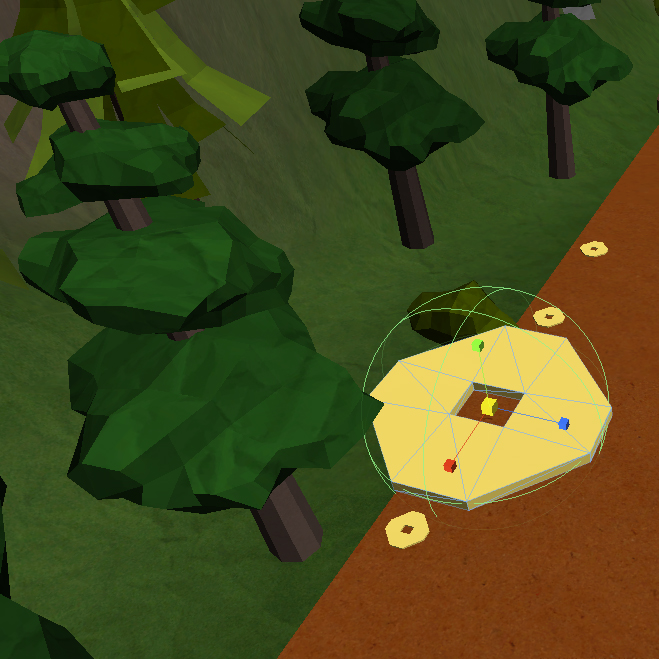
nity 3DBelow are some sneak peek photos. Actually, not really. I just wanted to highlight some of the tools and way that Unity works similarly to Maya. You’ll see that I’ve got a coin collectible highlighted, and it is currently in the movement tool. What I like about Unity and Maya is that they have similar controls. The movement tools allow you to manipulate the objects position on the map, the scale tool allows you to make them large or small, and the rotation tool, drum roll… allows you to rotate them. These are all very simple observations, but here is the point: The use of these tools give me more skills with which to produce and design games.

What’s great is that I’m getting to the point where I can create assets for ingame use, place them within the engine, and see how they look. Texturing is still a large challenge for me, but eventually I’ll get to the point where I can get these assets in game. It’s great to see how certain programs build upon each other. Maya allows me to create the art assets, but it seems to have set a standard so that I can create and manipulate environments easily in Unity. The next challenge is learning to program, but honestly, I think my efforts should be spent more on thinking about design and polishing my art skills in Maya.

coin screenshotAnother fun thing that I’ve been using within Unity are pre-fabs. These are tools where you cancreate a set of assets that you can populate easily throughout the level. This eliminates tedious copying and pasting of placing every single coin on the track. However, this does come with its drawbacks as well- these prefabs can be inflexible. However, they save me from the work of copying and pasting every coin. What I’ve been doing is placing a prefab down and then editing by adding or subtracting coins. We also have a zig zag coins prefabricated as well and it plays nicely through keyboard controls. However, when playing with Kinect, these are placed too close together when physically moving from side to side. I can stretch out their spacing by adjusting the prefab, but it’s not always optimal. Many a time I have had to go in and still tweak each asset one by one. So hypothetically, the prefabs make for less work, but I find that I still need to retouch most of them when placed so that the experience is better for the player.

Another thing I can help with recently is by doing quality assurance for the art. Kevin has had me take all of the assets that have been submitted into Unity and make sure that there aren’t duplicate faces, useless faces (ie, faces that we’ll never see in the game – like the bottom of the tree trunks -so they can be deleted to save on polys), and also that there is a standard nomenclature for the assets that we’re using. This helps the artists so that they can work on other assets and also helps me practice the skills I’ve been learning in Maya.


Whoa! Whoa! Whoa! What happened to that coin?

Whoa! Whoa! Whoa! What happened to that coin?


California & Zynga Visit

Posted: October 10, 2012 in Life & Beyond, MGS
Tags: , ,

I went to LA and San Francisco these past few weeks before and during fall break. While in San Francisco, I reconnected with my Burning Man friends and I also had the chance to visit Zynga and meeting one of the development directors of Atari’s new social game division. Zynga’s an interesting studio because I kind of get the vibe that while it’s a bright colorful place with a lot of cute dogs running around while their owners work, I don’t get the vibe that people love the games that they’re making. They all seem very tired and exhausted. However, it was a great opportunity to get insight into the workday of social game studios and opportunity to learn about metric definitions such as MAU, DAU, etc.zynga

My friend’s roommate is the development director for Atari’s new social game division and he gave me good insight into the difference between producers and project managers when it comes to social games. He told me that in his experience, PMs usually are involved in a lot of the number crunching and metrics of the games as well as development of their features and that producers usually keep them on schedule and give pushback to let the PMs know what is possible given the actual resources of the team. Definitely got a bunch of useful information while on my trip to San Francisco.

Iterations X Infinity

Posted: September 20, 2012 in MGS
Tags: , , ,

We have continued to iterate on the game. Rather than having multiple track types (ground and water), we are going to only have a ground track and cut the idea of the animals running/swimming through water as that set of animations would be too time consuming right now. I have also advocated for a forking path that will give players the opportunity to play the level differently. It also givers us the ability to create an “ideal path” where players can achieve a higher score via a faster run through the level. There are newish poses for the game’s new animals. The goat’s pose is still similar to the bull, the rabbit’s pose is your arms wide over your head still, and the tiger’s pose has players holding up their hands like a cat getting ready to pounce.

Finally, our modular levels are proving useful; we can quickly lay out a track for the game so that we can test to make sure the tracks are working efficiently. Since Unity has a terrain builder within it, we can also create a landscape of sorts around the track to give the level life and make it something more than just flat landscapes. We’ll be adding lots of art assets to it hopefully in the form of trees, caves, buildings and maybe other animals so that our Zodiac becomes alive.

Below is a picture of us in action with the poses that I’ve finalized.

Ashley is in the goat pose. The pose itself is grounded and actually very similar to the bull’s pose in the first build of the game. However, Jorge and I are tweaking it in Kinect so that it is more forgiving. That allows players to place their first wider (ie, outside of their hips) or more narrow (to the midline of their body). This creates a more enjoyable experience for the player so that they can focus on the game at hand rather than fighting with the pose.

Troy is in the bunny pose – it’s silly and elevated pose and hopefully elicits a connotation of surprise and excitement. Rabbits are hyperactive creatures, so in my mind this pose reflects the excited mind of a rabbit. It’s a higher pose than the others and creates a different feeling in the body (a stretch through the upper torso), and such activity is stimulating for the body to add to the game’s level of activity.

I am in the tiger pose. Gameplay tip: You don’t actually have to lift your leg, but you can if you want because the Kinect is actually looking for how your elbows and hands are in relation to your shoulders. That being said, hypothetically, players could do different things with their bodies as long as they’re doing the poses’ distinctive features (torso grounded and low for the goat, hands high, separated and spread apart for rabbit, and hands and elbows in their appropriate position in relation to the shoulders). This is another strong pose, it’s aggressive, and when I do it, I like to tense my body. This gives the sense of a tiger’s strength. Granted, players don’t need to tense their body when they strike the tiger pose, but it was a guiding idea in the design of the tiger.

Some of the emerging gameplay that can come out of these poses is for players to hit these poses while playing the game. Can they turn into the goat will scampering side to side to dodge the rocks and collect the coins? Can they jump and turn into the rabbit at the same time while avoiding logs? And can the player rapidly change from the tiger into the rabbit to maximize their speed in grass areas but also jump over logs quickly? It’s fun to see how fast you can switch between poses and what that makes for gameplay as you travel through the level.

poseswlogo

Maya & Unity & Dependencies

Posted: September 15, 2012 in MGS
Tags: , , , ,

One class that is proving to be useful this semester is our Production class in which we are studying Maya. While I will probably never be a professional modeler, I’m happy to learn the tools in Maya despite how daunting it is. It’s nice being able to understand how modeling works for the artist and it gives me more insight into the art production pipeline. I think my biggest challenge in Maya is the whole process of unwrapping UVs so that I can texture them. There’s some process and workflows within that where I have the hardest time mastering that skill.

Unity, as always, is full of little roadblocks. The engineers are working on getting our track system programmed and laid out. However, since we are approaching the game on a modular sense (ie creating tile sets that we can lay to create the track for the player), we can at least get the map laid out quickly. Once the programming magic is laid out, we should easily be able to create levels for the game.

So far I have finalized the poses for the games and have worked alongside engineers like Anurag as we place obstacles and collectibles in the game. He has started to give me mini tutorials on how to use the program to play test, so that has been very helpful. I’m learning a lot from him, and using Unity is a skill I can add to my resume.

In addition to showing me how to use Unity, Anurag is developing a programming tool that actually makes our level one that we can easily edit. One issue we encountered last semester was that when our characters turned along a path, it was never smooth and not conducive to a fun user experience. Thus, that was the reason our game was a straight-forward track that had no turns present in the gameplay. This issue affected the design greatly – even though people at EAE Open House had fun playing the game, we could sense that if the entire game was just a straight path, it could get boring very quickly. The levels become a bit lifeless. Here’s the secret though – even though the majority of the game will be played on a straight track, the addition of curved and forked paths give the player the illusion that they’re turning and give the level a new life. It seems simple, but there is so much work ahead of us to get the game to that point.

Anurag is crunching through heavy math to figure out this tool’s development for implementation within Unity. It makes me see how interconnected our skills are when we are making a game on any platform. We have rough drafts of level designs that we’re shooting for to test with these tools. However, those levels can’t be made until the tools have been completed and tested. Meanwhile, art is being created and iterated upon so that when the level design is ready, we can place the animals (with animations) to test bugs within the level. But there’s more – because we need the new poses implemented. That part isn’t too hard – Jorge and I partner and I do the poses and he sets them into the Kinect. However, we can’t efficiently test them until there is a working example of the game where the animated animal is running along the correctly tweened path. So as one can see- there are sooooo many elements to this game’s production. I haven’t even touched upon the production tasks that Karratti works on (powerpoints, scheduling, touching base with everyone). Our game falls heavily upon well-designed programming, which in turn needs solid art assets, and those parts need a solid level design for them to run upon. It requires that we are in constant contact and making sure that we run as a well oiled machine.

nity 3D

Zodiac Kids!

Posted: September 10, 2012 in Kinect, MGS

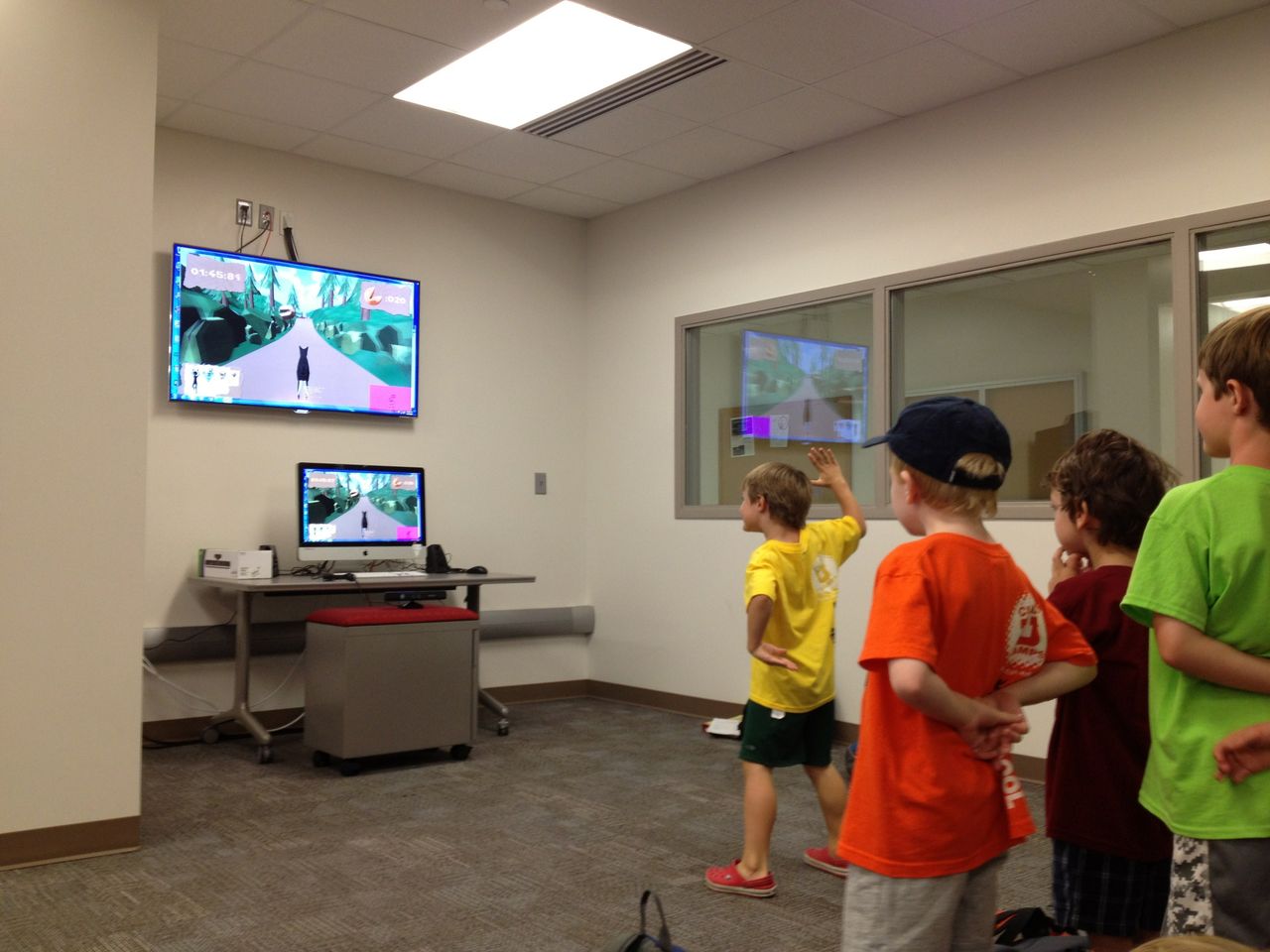
This summer we were fortunate to have kids come in during the University of Utah’s summer camp program and play-test our games. While one might question the amount of children around such expensive equipment, having actual kids play our game was worthwhile and showed us a lot of the issues with the poses that I had concocted for the game. For example, I imagined the cat pose as one that is similiar to the Japanese Lucky Cat –  The right arm is bent 90 degrees at the elbow with the hand up, and the left arm is bent 90 degrees at the elbow with the hand low. To me as a previous dancer, it was a move used many a time in Hip Hop choreography, but it was clear that it’s a hard move to pull off for many people and kids. Our culture is one where we don’t fully explore body movement – we sit in desks and travel passively in cars – so we don’t move our limbs in odd ways. The move felt very natural to me, but people have issues wit hit. Below is a picture of a kid awkwardly in the cat pose. I think it’s funny. but I was able to see the challenge for kids in looking at the pictures afterwards.

Super Awkward Cat Pose!

Super Awkward Cat Pose!

Another issue was the rat pose. We went through a few iterations of it – from a grounded pose to one where players hold their fingers over their head like they have mouse ears. In the gallery below you’ll see Brandon guiding a young child through the pose. Though it’s a cute one, I don’t like that it’s not very active. It’s also focused too much in the body, and sometimes the Kinect has issues recognizing it. This will definitely be changing due to the fact that we’re cutting all the animals and modifying poses. The rat’s pose is completely going away and will be something different for the rabbit that is replacing it.


Overall though, it was cute to see our target audience play the game and enjoy it. This event in the summer has given us a lot of thought about the game as we move forward into the future and this has been a guiding force in our decisions. We’ll be applying what we learned about the poses and kid’s behavior as we create the Beta build of Zodiac.

Zodiac Reunion!

Posted: August 20, 2012 in MGS
Tags: , , ,

Fall semester has begun. Our team has reunited and we’ve got a new set of goals for the game.

The game will become less linear. We will be creating tracks to give the illusion of turning and tracks that split as well to give players the option to take alternate paths. We’re also changing our animals. We now have a goat, rabbit and tiger. The game will still be on rails and the goal will be to reach the end as fast as possible. We discussed the merits of other ideas and drew upon games such as Agent Dash and Temple Run as inspiration and found ways to meld some of those games ideas together. When players come to the forks in the road, the game will automatically put them in the left turn if they’re on the left side of the track and vice versa. These little things should hopefully prove simple, but I’m sure the engineers will have their work cut out for them. There is a lot more on my shoulders in terms of design, but I believe using modular level design will help us whip out levels quickly and offer fun and frantic paths for players to use. We also need to tighten up the poses and offer variances for them.

It’s gonna be a busy semester, but man, it’s gonna be good.

Further insight on to some of the upcoming design changes:

Linear Design to Branching Design: We have a wonderful assortment of track pieces for the final level. Last semester we only had a linear level. This was due in part to the fact that the engineers had not been able to implement our level editor. This level editor will require a lot of engineering from their side – the animals must be able to stay on the track and not fly off. Eventually, we will apply this to elevated track pieces. By utilizing a level design that is branching, we give the players more options and reasons to replay the level. Since it is a student game, we will probably only get one level out of this project, so if we can shoot for a well-polished level with multiple branching paths, the game will have more life rather than just single play through.

Changing of the animals and their poses: We opted for these three animals – Goat, Rabbit, Tiger – because we feel that they will be more visually dynamic than the original cat, rat, and bull. We chose the goat because it still maintains the ramming aspect that the bull did within the first build, but also because we think it’ll be more interesting to look at than the bull. It’s more cute and I think the character’s polygonal build will read more goat than the bull ever did. The rabbit is our small character – larger than the rat – and I think the connotations with its abilities make more sense to players – rabbits jump high, run fast, and are comfortable in dark tunnel environments (like our caves). I think the choice of the tiger gives players a strong character to play as in this game and is in stark contrast to the choice of goat and rabbit. Where the goat is dopey but stalwart, the rabbit cute yet frantic, the tiger is strong and noble. It will be a solid choice for players in terms of speed and jump height. Its pose is an aggressive one, distinguishing it from the goats pose (a grounded silly flexing pose), and the rabbit’s upbeat, excited pose (hands high up in the air). These poses retain their dynamics from the previous semester (high, medium, low), but will have subtle changes that give more context to the transformation.

Oh, and next week? I’m gonna be in Burning Man! Time for some inspiration!

Zodiac

New-Microsoft-Logo-PPT-Backgrounds

The last few weeks in May were particularly exciting, not only because I turned 25, but because I was flown up to Microsoft’s campus in Redmond Washington to be a student producer at Microsoft Game Studio. The whole process was very fast. I had spoken with a university recruiter regarding an interview I had in March at GDC in San Francisco. She told me I interviewed well and would be invited back for interviews in Redmond, but most likely in the fall. Two weeks later, I received an email from the recruiter that they would actually be flying me up. Within 45 minutes, I had a plane ticket, hotel reservation and instructions and information on what my day would be like.

Arriving on the Microsoft Campus was a bit surreal. It was huge and the waiting area, while warm and inviting, still didn’t calm the nerves in my stomach. When I met my recruiter, I felt more at ease. He let me know they wouldn’t be asking me any of the legendary Microsoft logic questions, but that it would be more situational based questions regarding my experience as to how I would work with various teams. I ended up meeting with four interviewers, one of which I had interviewed me at GDC. After a long day of whirlwind questions and scenarios, I was done. I left as quickly as I entered and felt only the nervous tinge of hindsight 20/20 thinking of how I could have done better, though I did feel confident that I was on point 95% of the time.

When they called me on a Friday in June four weeks later, they let me know I didn’t get the job.

Emotionally devastated, frustrated and annoyed, my Friday most definitely ruined, I stopped applying for jobs altogether the rest of the summer. All the time and energy up until that point in interviews had been for naught, despite being invited to the final rounds most every time. Yet, looking back at it, I gathered a few things that I think bit me in the ass and allow for opportunities of growth.

-I might have gotten word vomit during my interview and in my nervousness mispronounced my interviewers names and probably didn’t offer the best analogies in my answers.

-I made the mistake of not being firm in the studio that I wanted to work at within Microsoft. When they asked me, I told them that I felt as an intern I couldn’t really ask for a particular studio of choice, but that I would be happy to try out any studio with a preference towards Kinect Labs or Epic. One interviewer said bullshit to Epic and said my heart would be more in Kinect. Probably didn’t help my case.

-I felt like my follow-up questions during the interviews were lame and if I felt that, I’m sure the interviewers did as well. My “great” questions were forgotten/muddled due to my nerves, and maybe the interviewers found them not particularly inquisitive.

-Despite Microsoft telling me to wear something business casual because they were more interested in me and not my outfit, I took heed of that advice. However, I feel like it was a test because despite wearing my power outfit (snazzy black jeans and a casual western-style top), the next time I go there I’m wearing a nicer outfit.

-I now know to say “areas of opportunity” rather than “areas where I’m lacking.” One of my interviewers bristled at that phrase, saying that it sounded like I didn’t think much of myself.

It was tough, wretched, and disappointing to not get the job after having it be a three month long process. However, there were valuable lessons in the experience. At my retail job in Apple, I decided to pursue becoming an administrator for the technician team at the store. It has skills applicable to being a producer and gave me a new way of approaching and anticipating roadblocks, an opportunity to multitask on many levels, and also a way to keep my job fresh. I know that this indicates the ability to take initiative and learn new skills.

When school starts up again, I’ll take these lessons to my future interviews.

EAE Day!

Posted: May 2, 2012 in MGS
Tags: , ,

We held the EAE Day in our new labs today in the Merril Engineering Building. It’s a gorgeous space with brand new top of the line work stations, and in a lab all to ourselves, so it’ll be a great place for getting work done.

The undergrad capstone class showed off their projects today and the Master’s program had our games on display as well. We were lucky enough to have Zodiac available to playtest today and we had people both young and old enjoying the game in its current form. People enjoyed striking the poses to transform into the current animals and due to a bug where the player character will “fly” when the player keeps jumping for the Kinect, we saw a lot of flying animals on our game. Overall, it was a great chance to see people’s reactions to this early build of my team’s thesis game. When playing the game, players are jumping up and down, dodging left and right and striking the various poses. It is most definitely a classic Kinect game in the sense that their body truly is the controller.

It has been a long semester and everyone has worked hard, especially the engineers and artists. We’ve got a game with potential and this summer will hopefully have the chance to have younger children play the game when we give tours of the program to young students at the University’s summer camps.

A few weeks ago I interviewed with Disney Interactive Media Group for a studio in Palo Alto at their Playdom Studios. I interviewed to be an intern in project management. While I didn’t get the job, I feel like it was a good experience (I was pretty much interviewed right on the spot when they called me), and I’m glad for it. Onwards and forwards!

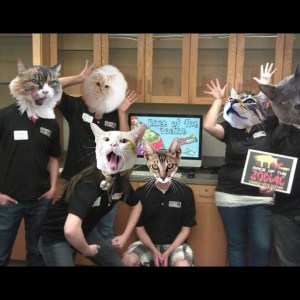
The Zodiac  team has been catified!

The Zodiac team has been catified!

Posted: April 4, 2012 in Kinect, MGS

This post is from the Origamer’s Blog as written by Karatti. It goes further into the changes for the game.

While examining the paper prototype that we’ve put together for use as our level design, something quickly became apparent – The change gates were not necessarily compulsory. Theoretically, one could never make a change, and still finish the level as quickly as if she had hit every change gate exactly on-time. While this may have been attractive for young gamers, it presented a more fundamental problem – There was little replayability outside of just loading up the game and choosing a different character to be first. Considering that the poses and transformations were to be one of our main “hooks,” this presented a problem.

As the leads consulted together, we talked about different possibilities. The first was a “looping” mechanic that would bring the player back around to the change gate if he missed it the first time around, giving him opportunities until he finally did the motion correctly. While this initially made us smile, we could see how this may become frustrating.

Other ideas included more complex and branching levels, encouraging exploration in order to find the “best path,” but such trial and error seemed a little less than compelling.

Finally, Josh and Jorge put together an interesting idea of using Temple Run as a model, with the transformations taking the place of the turns, and thereby giving us a model to increase the speed of the game. With this idea, we’ve decided to implement the mechanic behind the “looping gates” into something different and unique.

In what we’re calling “dynamic transformations,” the player will theoretically be able to play the entire, single-track level without ever changing. Instead of forcing the player to change, the player will instead be rewarded for changing, with an optimal form as the “fastest” in a certain part of the level.

By example, the Ox is the fastest swimmer, and so will move the fastest through a water section. If the player instead chooses to remain a cat, he’ll flail his way across the area, but will lose considerable time, unless he changes into the ox, at which time he’ll speed up. By the same token, if the player is trying to get through a small tunnel, the rat is her best bet, but the ox can just crash his way through it at a slower pace if she so chooses.

This dynamic system should allow for incentives to learn the poses and time the movements accordingly. As well, it will allow players of any skill level to play the game without being frustrated by having to “redo” sections if they miss a change gate. The entire level, in essence, will be a change gate.

During this discussion, the idea of “Epic Poses” came up, which seemed like an interesting addition. Borrowing an aspect of rhythm games like Rock Band or Guitar Hero, when the player hits an “Epic Pose Zone,” the game will slow down a little, and the player will need to correctly match a sequence of poses in succession. If he’s successful, this will trigger an “Epic Event,” which may include influences of anime “combat” scenes, or something to that effect. This will offer the player an awesome reward, as well as a significant shortcut which should help times, and encourage more skill instead of just barreling down the track.

Finally, the track has been determined to utilize three “slots,” and for the player to jump from one to the other instead of being free to move all over the track at will. Especially considering the speed that we’re aiming for, this should help the player to remain focused and invested in the gameplay instead of fighting against the Kinect to get it to do what it wants to do. As well, this takes some of the focus off of the steering and places it back onto the transformations, where it belongs.

We feel that this is a productive change, and though the “branching” system is simply cleverly hidden within the new design, it feels a little more fluid than it was. Also, this should significantly reduce the size of assets for the art team, though it may invariably increase the number of required animations. We’ll have to go down this path a ways and see how it goes.